
A Wide Range of Materials
Solutions for Every Industry

Well-Stocked & Ready to Ship
Fast & On-Time Delivery

Consistent Quality
Confidence in Every Production Run

Expert Consultation
Trusted Advice from
Our Specialists
ABOUT US
World Leather Center
A Leading One-Stop Supplier of Sewing Materials
We offer a comprehensive range of sewing materials, including both locally manufactured and internationally sourced products.
Our product range includes Spunbond, Canvas, Calico, Umbrella Fabric, Tarpaulin, Synthetic Leather, Plastic, and more.
Meeting the Needs of Sewing Businesses Across Industries
We leverage modern management technology to ensure efficient and reliable operations.
With a diverse range of quality-standard products, a large warehouse, and ready-to-ship inventory, we provide fast and reliable delivery.
Backed by over 30 years of industry experience.

"Choose WLC for Quality Materials Behind Your Products."


Blog
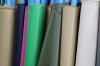
PVC-coated fabric is widely used in the bag industry, promotional products, outdoor equipment, protective covers, and products that require greater durability than conventional lightweight fabrics. It is typically made from a polyester woven base fabric with a layer of PVC, or polyvinyl chloride, applied to the back to enhance structure, durability, and resistance to water penetration.
One of the key advantages of PVC-coated fabric is its availability in different thicknesses and strength levels. Options range from materials suitable for medium-duty bags to heavier, more structured fabrics for travel bags, tool bags, and products designed for demanding use.
Common specifications include 300D, 420D, 600D, and 1680D. These figures do not directly indicate fabric quality; rather, denier relates to the linear mass density of the yarn used to make the fabric. Each specification is suited to different applications. Choosing a fabric that is unnecessarily heavy can increase product weight and cost, while a fabric that is too lightweight may not provide sufficient strength.
Beyond denier, PVC-coated fabrics can vary in weave construction, fabric weight, the amount and characteristics of the PVC coating, and the appearance of the coated backing. WLC offers a range of options, including 300D PVC, 420 PVC, various 600D PVC specifications, and 1680D PVC. Most use polyester as the base fiber, and several options are available in widths of approximately 58 inches.
For this reason, selecting PVC-coated fabric should involve more than simply asking, “What denier do I need?” Start by identifying the intended product, the load it must support, whether it needs to hold its shape or fold easily, whether it will be exposed to water or outdoor conditions, and which printing process may be required.
This article explains what PVC-coated fabric is, what the PVC coating does, how 300D, 420D, 600D, and 1680D differ, how PVC-coated fabric compares with PU-coated fabric, and whether it is waterproof. It also explores suitable bag and outdoor applications and explains how to choose the right specification before placing a large production order.
The goal is to help factories, business owners, product brands, purchasing teams, retailers, and product developers select PVC-coated fabric that meets their application requirements while keeping costs under control.
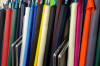
What Is Polyester and Nylon Fabric? Types, Properties, Uses, and How to Choose the Right Fabric
Polyester and nylon fabrics are widely used in the textile and product manufacturing industries. Although fabrics commonly referred to as “umbrella fabric” are often associated with rain umbrellas, polyester and nylon fabrics have a much broader range of applications. They are used to make bags, fabric pouches, drawstring bags, jackets, rainwear, tents, outdoor equipment, promotional products, event merchandise, advertising materials, and custom-printed products.
One of the main reasons these fabrics are so popular is their versatility. Different fabric constructions and finishes offer different properties to meet specific application requirements. Some fabrics are lightweight and easy to fold and store, while others offer high tensile strength and resistance to tearing. Certain fabrics feature surface coatings to improve water resistance, while others are specifically designed for printing applications.
The market offers a wide variety of polyester and nylon fabrics, including PU-coated fabrics, PVC-coated fabrics, Ripstop, Taffeta, Pongee, and Taslan. These fabrics also differ in yarn size, weave density, fabric weight, coating, and surface finish.
For example, fabric used to make foldable bags may need to be lightweight and easy to pack. In contrast, fabric for backpacks or tool bags may require greater strength and abrasion resistance. Fabrics intended for jackets must also be evaluated for softness, weight, and wearing comfort.
Choosing fabric for outdoor applications involves even more considerations. Buyers need to assess weight, tensile strength, tear resistance, water protection, environmental durability, and the product's intended use. Even a high-quality fabric may not be suitable if it does not meet the requirements of the finished product.
Another common challenge for fabric buyers is understanding technical specifications such as 210D, 420D, 600D, 1680D, and 210T. A higher number does not automatically mean better performance, and 210D and 210T do not refer to the same measurement or fabric specification.
Choosing the right fabric should therefore begin with more than the question, “Which fabric is the best?” or “Which fabric is the cheapest?” Instead, buyers should first identify the intended product, how it will be used, and which material properties are essential for the application.
This article covers the fundamentals of polyester and nylon fabrics, including their types, key properties, and applications. It also explains the differences between polyester and nylon, PU and PVC coatings, Ripstop construction, water resistance, and the technical specifications 210D and 210T. In addition, it explores how to select suitable fabrics for bags, clothing, umbrellas, tents, outdoor products, promotional merchandise, and printing applications.
This guide is intended for business owners, manufacturers, brands, fabric retailers, procurement teams, designers, and product developers who want to make informed material decisions beyond simply comparing colors, prices, or product names.
By understanding these fabric types and their characteristics, businesses can select materials that better match their product requirements, intended applications, and production needs.
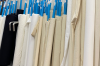
What Is Twill Fabric? A Complete Guide to Its Properties, Types, Advantages, Disadvantages, and Uses
What Is Twill Fabric? Properties, Types, Advantages, Disadvantages, and Applications
If you have ever seen fabric with clearly defined diagonal lines running across its surface, such as denim, trousers, workwear, aprons, or certain types of bag materials, there is a good chance that the fabric uses a twill weave structure. In Thailand, fabrics with this structure are commonly known as “Twill Fabric” or “ผ้าลายสอง” in Thai.
Twill Fabric does not refer to a specific type of fiber. Instead, it describes a weaving pattern that creates diagonal lines across the fabric surface. This distinguishes it from plain-weave fabrics, which are typically woven by interlacing the yarns in a simple over-one, under-one pattern.
Because of this structure, Twill Fabric can be made from various types of fibers, including:
Cotton
Polyester
TC or Polyester-Cotton blends
Rayon
Linen
Wool
Other fiber blends
So, when people ask:
What is Twill Fabric?
Is Twill Fabric made from cotton?
What is Twill Fabric used for?
Can Twill Fabric be used to make bags?
What is the difference between Twill Fabric and Canvas?
What is the difference between Twill Fabric and Calico Fabric?
Is Twill Fabric the same as denim?
The answers should not be based on the term “twill” alone.
The term Twill describes the fabric’s weaving structure, but it does not tell you everything about the material, such as:
What type of fiber it is made from
Its weight
Its thickness
Its strength and durability
Whether it is water-resistant or waterproof
Whether it stretches
Whether it shrinks
Which applications it is suitable for
Choosing the right Twill Fabric therefore requires consideration of several factors:
Composition + Twill Structure + Weight/GSM + Density + Finishing + Application
This article explores what Twill Fabric is, how it is woven, its properties and types, its advantages and disadvantages, and its various applications. It also explains how Twill Fabric differs from Calico Fabric, Canvas, and Denim, along with practical tips for selecting the right material for clothing, bags, uniforms, premium products, and large-scale manufacturing.

เว็บไซต์นี้มีการใช้งานคุกกี้ เพื่อเพิ่มประสิทธิภาพและประสบการณ์ที่ดีในการใช้งานเว็บไซต์ของท่าน ท่านสามารถอ่านรายละเอียดเพิ่มเติมได้ที่
นโยบายความเป็นส่วนตัว and นโยบายคุกกี้
Powered By
 MakeWebEasy
- Home Home
- Product Product
- Applications Applications
- Blog Blog
- About us About us
- Contact us Contact us
Home
Home
Home
Home